Suppose you're deciding how much gas to purchase. The gas station charges $x per gallon, but you also have to pay a gas tax of $y per gallon. The effective price of gas for you, then, is $(x+y) per gallon.
Suppose first that y = 0.25. In that case, let's say you want to buy 10 gallons. Now suppose that y = 0.75. Do you still want to buy 10 gallons? Those same 10 gallons would cost you $5 extra. Even if that isn't enough to make you want to buy a little less gas, it's plausible that someone out there is going to buy fewer gallons than they otherwise would, right?
How will the change in y impact the government's income? On the one hand, y goes up, which means every gallon purchased adds $0.50 more to the government's income. On the other hand, the gallons of gas purchased probably go down, which means every gallon not purchased deducts $0.25 from the government's income. If the former effect dominates, then the government's income rises with the tax hike. If the latter effect dominates, then the government's income falls with the tax hike.
Suppose you're deciding how many hours to work. Your employer pays you $x per hour, but you also have to pay a tax of y% on your wages. Your effective wage, therefore, is $x(1 - y/100) per hour.
Suppose first that y = 0.25. In that case, let's say you want to work 40 hours. Now suppose that y = 0.75. Do you still want to work 40 hours? Those same 40 hours would earn you only half as much. Even if that isn't enough to make you work less, it's plausible that someone out there is going to work fewer hours than they otherwise would, right?
How will the change in y impact the government's income? On the one hand, y goes up, which means every hour worked secures the government more income. On the other hand, hours worked probably go down, which means every hour not worked loses the government more income. If the former effect dominates, then the government's income rises with the tax hike. If the latter effect dominates, then the government's income falls with the tax hike.
What's the difference? Well, if the price of gas goes up, you become poorer, which makes you buy fewer things in general (and gas in particular). If the price of work goes up, you still become poorer, but that makes you work more hours to make up the difference. Thus, there is a third effect, which reinforces the revenue-reducing aspect of the gas tax, but reinforces the revenue-raising aspect of the wage tax. Common sense suggests, therefore, wage tax hikes are likely to be more successful in raising revenues than gas tax hikes.
What do the data tell us? Higher income taxes unambiguously raise more revenue, but some expected revenue is lost because some people do not generate (or report) as much income. In other words, the supply-siders had a point, but one that was way overblown. So when peeps tell you cutting taxes raises revenue, understand that there are multiple things going on, and that we have pretty solid evidence that other, more intuitive effects, tend to dominate in the end. Doesn't mean higher tax rates are desirable, but they would raise more revenue--possibly a lot more.
Showing posts with label tax reform. Show all posts
Showing posts with label tax reform. Show all posts
Wednesday, February 22, 2012

Friday, February 10, 2012
Must employer-provided health insurance plans cover birth control?
Some people believe they must. Other people disagree. Two questions occur to me in connection with this debate: First, what does birth control have to do with health insurance? Second, what do employers have to do with their employees' health insurance?
Insurance is supposed to prepare the insured for unpredictable, expensive scenarios. Needing to purchase birth control pills is a perfectly routine event. The pill isn't very pricey, either. Why, then, do people buy them with their health insurance instead of just reaching for their purse? It's not like car insurance plans cover fuel expenses.
What's more, your employer has no say over what your car insurance plan covers. Why, then, does it have a say over what your health insurance plan covers? What's so special about health insurance?
Believe it or not, many economists say that we have the tax code to thank for these curiosities of the US health care system. The story begins with World War II. One of the ways in which the US government financed the war effort was by printing a lot of US currency, causing excessive inflation. The government responded with wage controls, among other measures, legally preventing wages from giving way to inflationary pressures. Of course, the laws of supply and demand cannot be legislated away. Employers responded to the inflationary pressures by offering workers benefits besides wages, most commonly health insurance, simply because doing so was legal.
As wage controls were relaxed, however, congress began to recognize employer-provided health insurance as a form of income, thus subjecting it to taxation. By that point, though, labor unions had become staunch defenders of the tax-free status of employer-provided health insurance, discouraging congress from closing the loophole. Ever since, employer-provided health insurance has been tax deductible. Sound like intelligent design to you?
Why does the tax-free status of employer-provided health insurance matter? Suppose you wish to buy birth control pills. If you decide to buy them with your employer-provided health insurance, then you will pay for them with pre-tax dollars, effectively rendering them less expensive. If, on the other hand, you decide to pay for them out of pocket, then you will pay for them with post-tax dollars, effectively rendering them more expensive. Note that this does not work if you purchase your own health insurance plan. Health insurance is only tax deductible if it is provided by your employer. This explains not only why most people receive their health insurance from their employer, but also why cheap, routine medical expenses tend to be covered under health insurance plans.
For these reasons, a perfectly straightforward policy issue (whether every woman should have financial access to birth control) is, in the context of our distorted health care financing system, transformed into a mystifying debate about the complex relationship between your health insurance provider, your employer, your government, and you.
So, what's my proposal to resolve this controversy? Reform the tax code. Only then will we be able to meaningfully debate the proper role of government. Also, everyone needs to take a pill. A chill pill, that is...
Insurance is supposed to prepare the insured for unpredictable, expensive scenarios. Needing to purchase birth control pills is a perfectly routine event. The pill isn't very pricey, either. Why, then, do people buy them with their health insurance instead of just reaching for their purse? It's not like car insurance plans cover fuel expenses.
What's more, your employer has no say over what your car insurance plan covers. Why, then, does it have a say over what your health insurance plan covers? What's so special about health insurance?
Believe it or not, many economists say that we have the tax code to thank for these curiosities of the US health care system. The story begins with World War II. One of the ways in which the US government financed the war effort was by printing a lot of US currency, causing excessive inflation. The government responded with wage controls, among other measures, legally preventing wages from giving way to inflationary pressures. Of course, the laws of supply and demand cannot be legislated away. Employers responded to the inflationary pressures by offering workers benefits besides wages, most commonly health insurance, simply because doing so was legal.
As wage controls were relaxed, however, congress began to recognize employer-provided health insurance as a form of income, thus subjecting it to taxation. By that point, though, labor unions had become staunch defenders of the tax-free status of employer-provided health insurance, discouraging congress from closing the loophole. Ever since, employer-provided health insurance has been tax deductible. Sound like intelligent design to you?
Why does the tax-free status of employer-provided health insurance matter? Suppose you wish to buy birth control pills. If you decide to buy them with your employer-provided health insurance, then you will pay for them with pre-tax dollars, effectively rendering them less expensive. If, on the other hand, you decide to pay for them out of pocket, then you will pay for them with post-tax dollars, effectively rendering them more expensive. Note that this does not work if you purchase your own health insurance plan. Health insurance is only tax deductible if it is provided by your employer. This explains not only why most people receive their health insurance from their employer, but also why cheap, routine medical expenses tend to be covered under health insurance plans.
For these reasons, a perfectly straightforward policy issue (whether every woman should have financial access to birth control) is, in the context of our distorted health care financing system, transformed into a mystifying debate about the complex relationship between your health insurance provider, your employer, your government, and you.
So, what's my proposal to resolve this controversy? Reform the tax code. Only then will we be able to meaningfully debate the proper role of government. Also, everyone needs to take a pill. A chill pill, that is...
Friday, January 27, 2012
Utopian tax policy
Every month, the government would provide each citizen with a check for, say, $250. Businesses would report their revenue from sales, from which they would deduct the cost of their inputs (including labor costs), paying a flat rate of, say, 25% on the difference. Individual workers would report their wages and benefits, paying in line with a graduated rate schedule beginning at 0% for very low-wage workers, and ending at 25% (the rate on businesses) for very high-wage workers. There would be no further deductions, exclusions, credits, etc.
There would also be selective taxes on negative externalities (e.g., pollution), subsidies for positive externalities (e.g., basic scientific research), and if necessary, paternalistic carrots and sticks (e.g., encouraging retirement savings, discouraging addictive drugs).
That's it. It would take a worker about 5 minutes, and a business about 15 minutes, to complete their respective tax returns each year. No Turbotax, no tax attorneys, just your basic calculator and a postcard.
I'm a gradualist, so I wouldn't shift to this regime overnight. To move in the right direction, however, we should begin to broaden the tax base (eliminate wasteful deductions, exclusions, credits, etc.), lower tax rates on saving and investment (cut personal income, corporate income, capital gains, dividend, and inheritance tax rates, among others), up the progressivity of consumption taxes (e.g., payroll taxes), implement Pigouvian (externality-correcting) taxes/subsidies, and reform entitlements--substituting a lump-sum subsidy for Medicare, Medicaid, Social Security, etc. Doing a bit on each of these fronts would be a very good start, and would also be a good way to go about reigning in the long-run budget deficit (a la Bowles-Simpson).
My proposal (which is little different from the Bradford "X Tax") is rather uncontroversial in public finance circles. Note also that under the ideal system, Mitt Romney would (as far as I can tell) have an effective (statutory) tax rate near 0%. So, there's that.
There would also be selective taxes on negative externalities (e.g., pollution), subsidies for positive externalities (e.g., basic scientific research), and if necessary, paternalistic carrots and sticks (e.g., encouraging retirement savings, discouraging addictive drugs).
That's it. It would take a worker about 5 minutes, and a business about 15 minutes, to complete their respective tax returns each year. No Turbotax, no tax attorneys, just your basic calculator and a postcard.
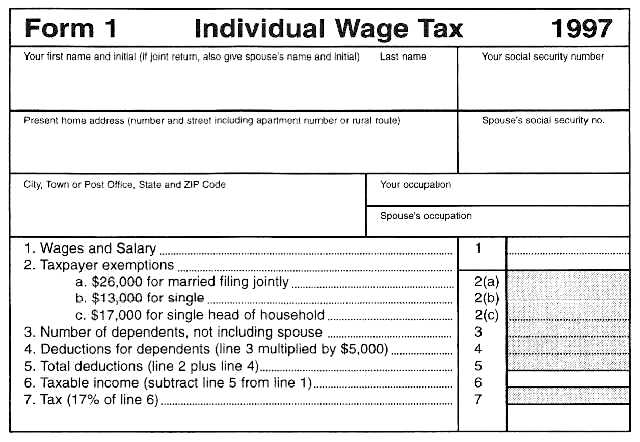
I'm a gradualist, so I wouldn't shift to this regime overnight. To move in the right direction, however, we should begin to broaden the tax base (eliminate wasteful deductions, exclusions, credits, etc.), lower tax rates on saving and investment (cut personal income, corporate income, capital gains, dividend, and inheritance tax rates, among others), up the progressivity of consumption taxes (e.g., payroll taxes), implement Pigouvian (externality-correcting) taxes/subsidies, and reform entitlements--substituting a lump-sum subsidy for Medicare, Medicaid, Social Security, etc. Doing a bit on each of these fronts would be a very good start, and would also be a good way to go about reigning in the long-run budget deficit (a la Bowles-Simpson).
My proposal (which is little different from the Bradford "X Tax") is rather uncontroversial in public finance circles. Note also that under the ideal system, Mitt Romney would (as far as I can tell) have an effective (statutory) tax rate near 0%. So, there's that.
Subscribe to:
Posts (Atom)